
Saganode vs. Luma
Saganode keeps the narrative system behind multi-model production persistent: trusted story knowledge, chronology, relationships, and creator-governed sequence intent remain connected across outputs.
Luma carries creative-production context from a brief into image and video work. Saganode carries narrative context across the universe, its stories, relationships, chronology, and production plans.
| Decision dimension | Saganode | Luma |
|---|---|---|
| Primary input | Connected universe and story context | Creative brief and media references |
| Primary outcome | Narrative development, visual planning, and Sequence Plans | Generated and edited media deliverables |
| Persistent context | Explicit entities, relationships, facts, recommendations, and chronology | Agent and project production context |
| Models | Model-agnostic planning layer | Luma Ray, Luma UNI, and a wider model ecosystem |
| Editing and delivery | Handed to the external production stack | Native generation, editing, and reframing |
| Developer access | Claims depend on shipped Saganode integrations | Official production APIs and SDKs |
| Best fit | Long-running fictional worlds and creator-governed meaning | Creative execution across media models |
Narrative Collapse: production context is not the whole story context
Generative tools optimize the next output. Saganode preserves the narrative system that keeps successive outputs coherent.
Luma can carry a creative brief and references through media production. This becomes inductive storytelling when successive story developments are derived primarily from the production context currently at hand. Narrative Collapse describes what can still be lost around that process: explicit lore, relationship state, chronology, canon decisions, and the provenance of the narrative assumptions behind each asset. Saganode keeps that universe model persistent across stories and outputs.
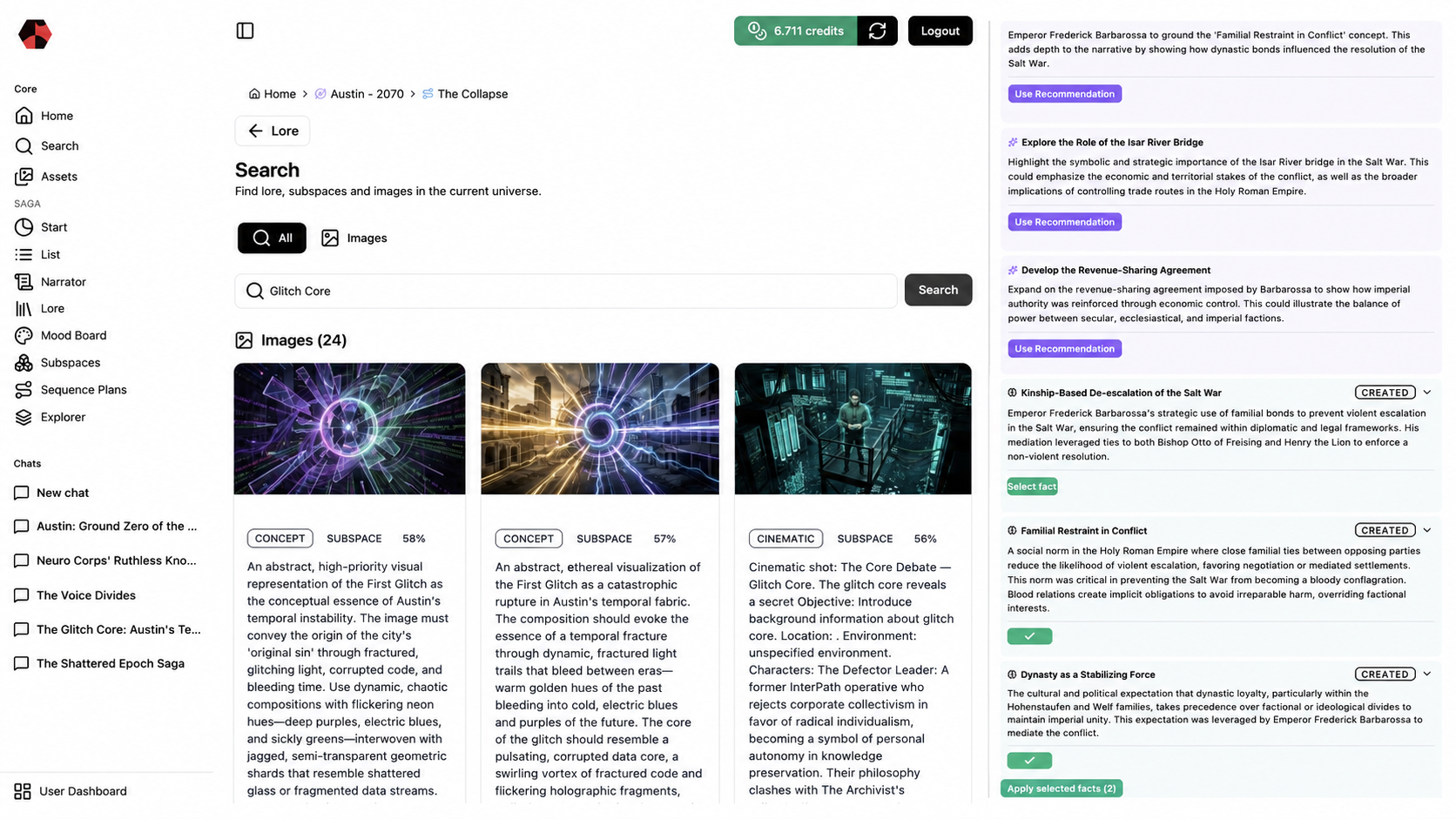
The workflow shows how production context remains derived from a larger story system. See all eight Narrative Collapse proofs.
Luma is now a production platform, not only a clip generator
Current Luma positioning centers a creative workspace and developer platform for generating and editing images and video. Its current model family includes Luma UNI for images and Ray3.2 for video, with API and SDK access for production workflows.
That breadth makes Luma a strong execution environment. Saganode does not replace its generation, editing, reframing, keyframe, or delivery capabilities.
The distinction is the type of context
A production system can carry a brief, references, and prior outputs through a workflow. A narrative system must additionally express who and what exist, how they relate, what happened when, which statements are established, and what a proposed change means for the wider story.
Saganode makes those narrative structures inspectable. The creator can work inside a focused Subspace while the material remains connected to the broader universe.
Keep the brief connected to the evolving world
The creative brief should not become an isolated snapshot of the story. Saganode can derive sequence and shot direction from current story context, then maintain the origin and role of related production assets.
Luma can execute that direction across image and video work. Saganode preserves the narrative source of truth that remains useful when a model, asset, or delivery format changes.
Explore scalable video content architecture
Can Saganode and Luma work together?
Potentially. Saganode can supply upstream narrative and sequence direction; Luma can generate and edit media from a production brief and references. A direct automated handoff would depend on the live integration capabilities of both products.
Frequently asked questions
Is Saganode a Luma alternative?
Not for image and video generation. It is an alternative approach to organizing the story knowledge that should guide creative production.
Is Luma still Dream Machine?
Current official positioning uses Luma App, Luma Ray, and Luma UNI. Older Dream Machine and Photon descriptions should not be used as shorthand for the current product.
Which tool has better context?
The contexts serve different purposes. Luma's context supports media production; Saganode's context represents the connected narrative universe and creator-governed story decisions.
Explore next
Primary sources
- Luma official product information
- Luma Agents API
- Luma Ray3.2
- Saganode scalable production architecture
Product information reviewed September 4, 2026. Models, APIs, and commercial terms may change.