
A growing narrative universe whose lore, relationships, timelines, decisions, and visual plans remain connected across stories and outputs.
Story world software compared
Saganode vs.
Lore Machine
Two different ways to build with stories: Lore Machine turns ideas into playable, remixable audiovisual LOREs. Saganode gives creators connected context for developing coherent story worlds and carrying narrative intent into visual planning.
Product information reviewed September 4, 2026
The Saganode advantage
The World remains a system—not only an output.
Turning an idea or long-form text into an animated, interactive story that readers can play, remix, follow, and access through its native platform.
The products overlap in AI-assisted storytelling, but begin at different points: a connected narrative system versus a playable media object.
Narrative Collapse
The next output can work while the larger story quietly breaks.
Generative tools optimize the next output. Saganode preserves the narrative system that keeps successive outputs coherent.
This pattern is inductive storytelling: Lore Machine can turn the currently available story input into a compelling interactive object. Saganode addresses the structural risk around continued generation by keeping characters, relationships, facts, chronology, decisions, and assets connected to an explicit universe model instead of reconstructing them from the latest prompt.
See the eight product proofs →At a glance
Two starting points.
Two different outcomes.
| Decision dimension | Saganode | Lore Machine |
|---|---|---|
| Primary workspace | Connected story universe | Playable LOREs and Worlds |
| Main outcome | Coherent development and visual planning | Publishable, remixable audiovisual stories |
| Workflow begins with | Lore, relationships, timelines, or story context | An idea, prompt, screenplay, book, or pasted story |
| Continuity approach | Explicit connected context and creator decisions | Persistent cast, locations, canon, and narrative physics |
| Audience experience | Upstream of publishing | Native reading, choices, discovery, and remixing |
| Visual output | Sequence Plans, storyboards, and production assets | Generated imagery, voice, music, motion, video, and choices |
| Best fit | Complex worlds, long-form continuity, and original IP | Interactive-story creation and creator publishing |
The essential difference
A destination for stories—or the system behind them.
Lore Machine is designed around the LORE, a format people can read, play, extend, and remix. A World holds multiple LOREs together through a shared cast, canon, locations, and narrative physics. Creation, consumption, participation, and monetization become one loop.
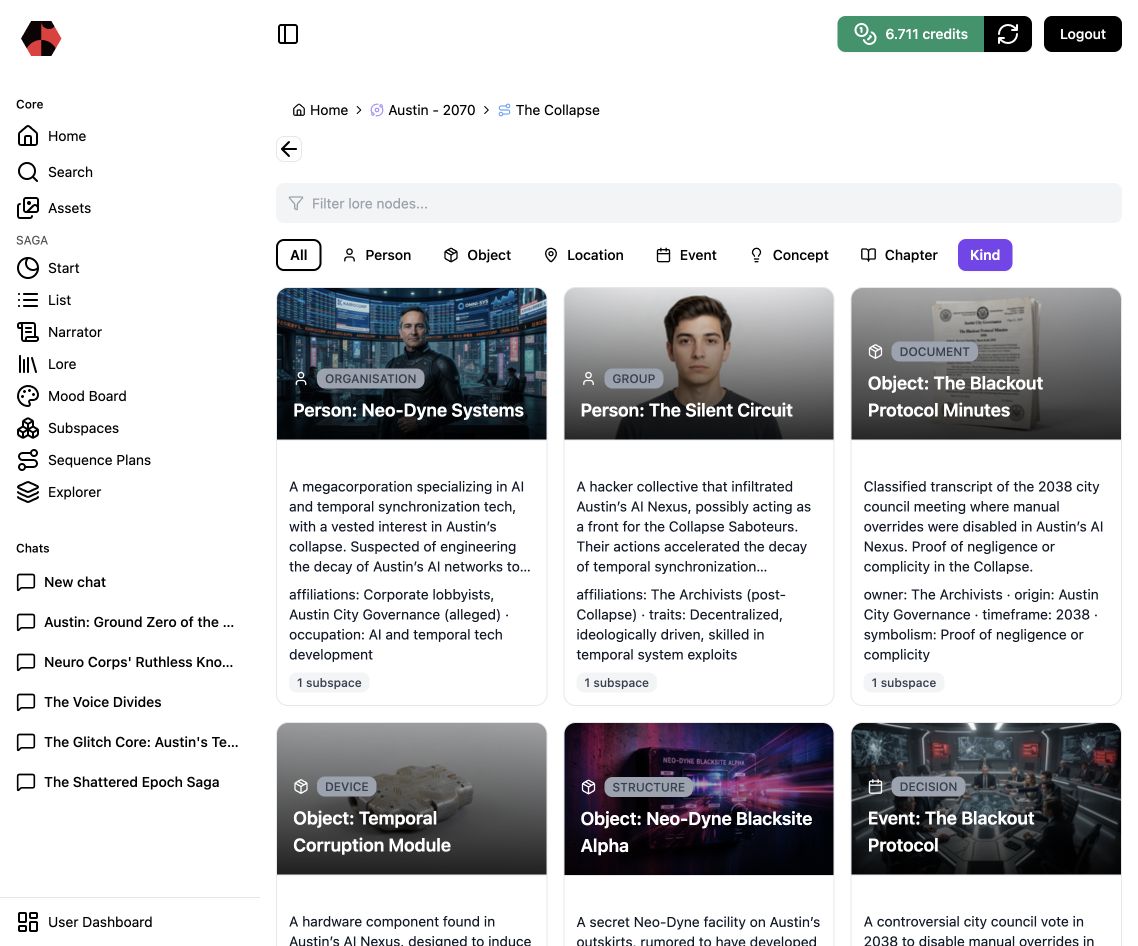
Saganode is designed around the connected story universe. It structures characters, places, relationships, events, concepts, timelines, stories, and visual references so that new work can grow from shared context.
Continuity and control
Keep proposals separate from what is true.
Lore Machine describes Worlds as unified by cast, canon, and narrative physics, with consistent characters and locations supporting branching and remixing.
Saganode emphasizes inspectable context and human-guided decisions. The Narrator works from selected story knowledge and distinguishes established facts from recommendations, so exploring an alternative does not silently turn it into canon.
Explore the Narrator →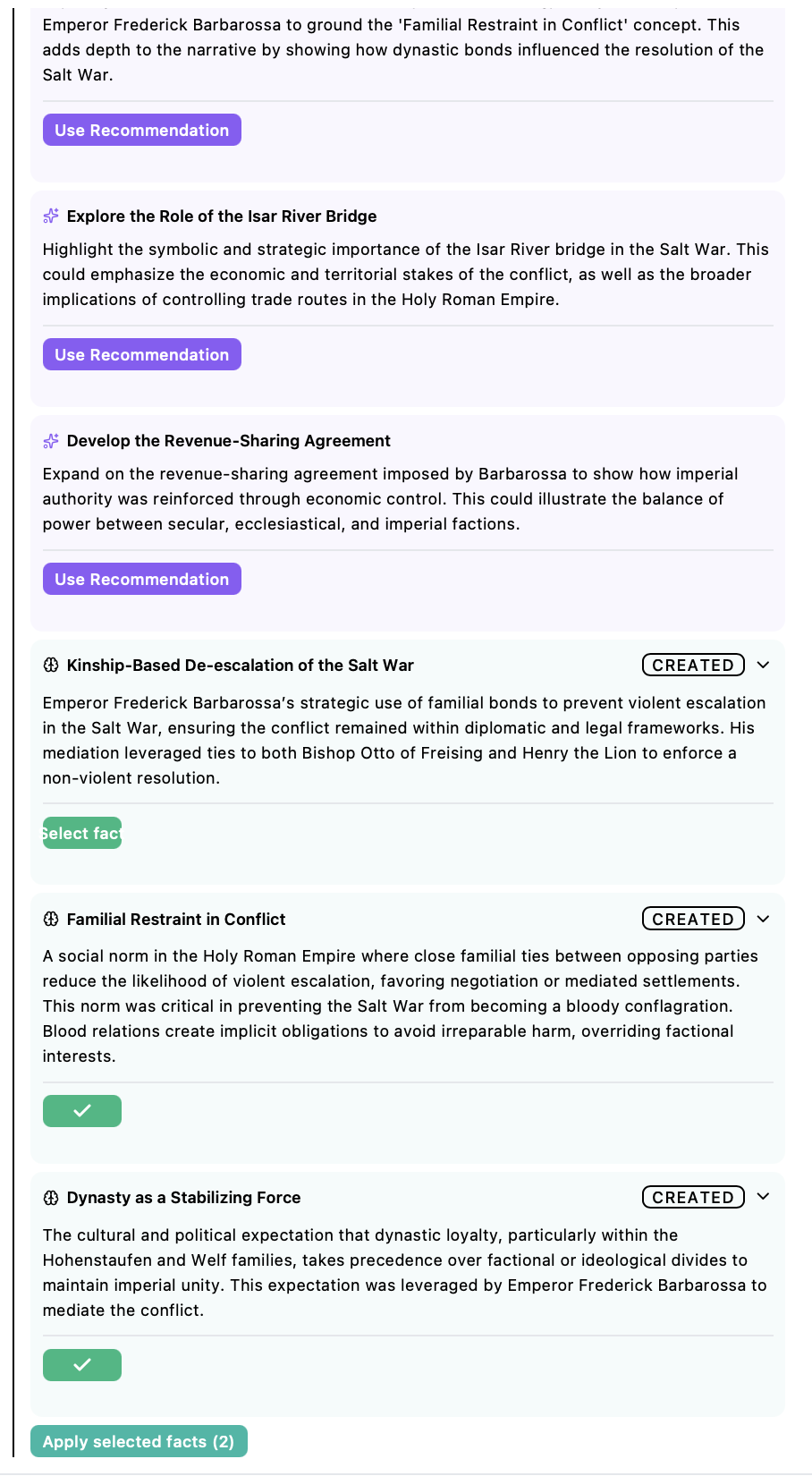
From story to visuals
Fast media output—or deeper production intent.
Lore Machine compresses the route from text to an audiovisual result: illustrated and animated blocks can include narration, sound, choices, and video inside a native reading experience.
Saganode works upstream. Sequence Plans connect narrative context with scenes, shots, dialogue, camera direction, visual references, and production assets—preserving why a scene exists as work moves toward external generation and finishing tools.
See story to storyboard →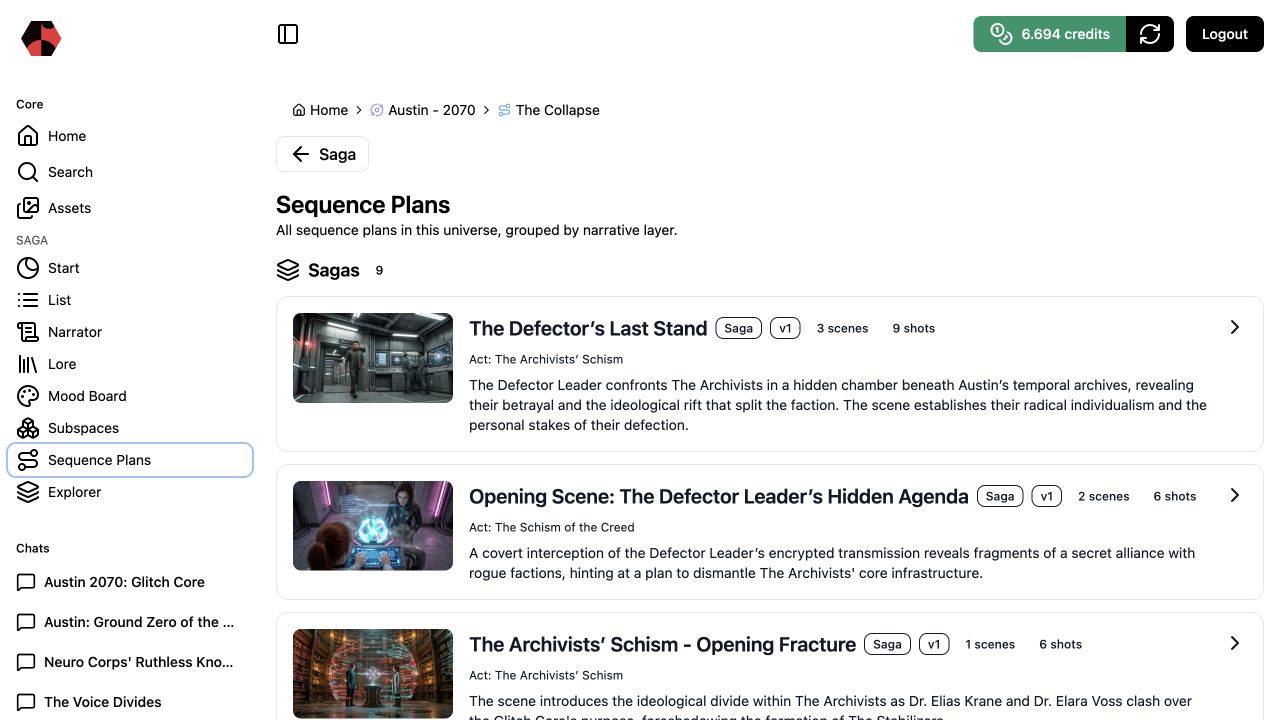
Workflow strengths
Where the products create value.
Saganode is built to…
- develop a universe before committing to one output;
- connect lore, relationships, and timelines;
- keep facts and recommendations distinct;
- preserve intent across story and visual planning;
- prepare sequences and shots from connected context;
- support long-form or cross-media original IP.
Lore Machine specializes in…
- turning an idea or text into an interactive story quickly;
- publishing into a native reader experience;
- supporting reader choices, branches, and remixing;
- inviting a community into a shared World;
- combining text, images, voice, motion, and video;
- offering paid access to a serialized World.
Questions
Saganode and Lore Machine FAQ
Is Saganode an alternative to Lore Machine?
Yes, when you are comparing tools for AI-assisted worldbuilding and story development. They are not direct substitutes in every workflow: Lore Machine centers playable audiovisual stories and publishing; Saganode centers connected story knowledge, narrative coherence, and upstream visual planning.
Which tool is better for worldbuilding?
Lore Machine fits a World that readers enter through interactive LOREs and community participation. Saganode fits creators who need to model, navigate, and develop the lore, relationships, timelines, and stories underneath a complex universe.
Which tool is better for interactive stories?
Lore Machine is the more direct choice for a finished interactive reading experience. Saganode can help develop the world and narrative logic behind interactive work, but it is not positioned as a consumer interactive-fiction player.
Can Saganode generate images and video like Lore Machine?
Saganode connects story context to visual references, storyboards, Sequence Plans, and production assets. It is not positioned as a replacement for a dedicated image/video generation and finishing stack.
Can I use both?
Potentially. You could develop lore, relationships, chronology, and story logic in Saganode, then carry that material into an interactive production workflow. Review export options, privacy controls, and current terms before moving confidential or commercial IP between services.
Primary sources
Verify the products directly.
- Lore Machine product site ↗
- Lore Machine user manual ↗
- Saganode fictional IP development
- Saganode asset provenance workflow
Product information reviewed September 4, 2026. Features, policies, and commercial terms may change.
Build the context behind every story
Give the universe one connected foundation.
Develop the world, explore what could happen next, and carry its meaning from story context to storyboard.