
Saganode vs. Sudowrite
Saganode goes beyond manuscript context: it keeps the wider narrative universe—its lore, relationships, chronology, and visual development—connected across stories and outputs.
Both products help fiction creators develop stories with AI, but the work revolves around different primary objects. Sudowrite centers the manuscript and the writing process. Saganode centers the connected universe behind one or many stories.
| Decision dimension | Saganode | Sudowrite |
|---|---|---|
| Primary workspace | Connected universes, stories, lore, relationships, and Subspaces | Manuscripts, projects, and Story Bible |
| Main outcome | Coherent story development and context-rich visual planning | Drafted and revised fiction prose |
| Persistent context | Typed lore, relationships, timelines, and scoped narrative context | Story Bible fields and shared Series material |
| AI contribution | Contextual exploration with facts and recommendations kept distinct | Drafting, rewriting, brainstorming, feedback, and analysis |
| Series work | Universe-level context across sagas, stories, and assets | Shared characters, worldbuilding, outlines, and Series context |
| Visual development | Mood Boards, Sequence Plans, storyboards, and production assets | Secondary to the prose workflow |
| Best fit | Evolving story worlds, original IP, and cross-media development | Novelists focused on writing and revising manuscripts |
Narrative Collapse: when the next scene weakens the larger story
Generative tools optimize the next output. Saganode preserves the narrative system that keeps successive outputs coherent.
Sudowrite can help produce the next sentence, scene, or revision. This is a form of inductive storytelling: development proceeds from the context immediately available. Narrative Collapse describes the risk that this process gradually disconnects character behavior, relationships, knowledge, chronology, and canon from the wider universe. Saganode keeps those elements explicit and connected, so a locally convincing scene can be evaluated against the system behind the manuscript.
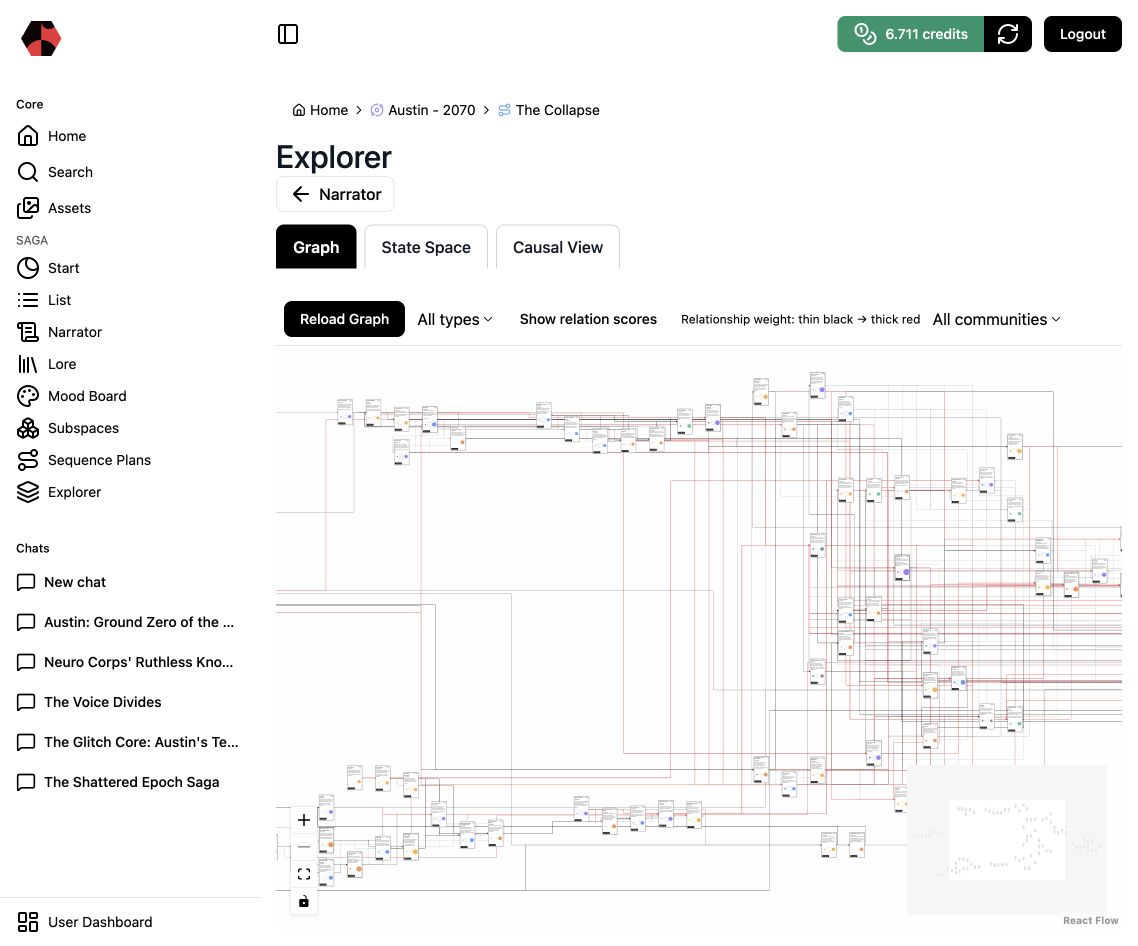
The graph is one visible proof in an eight-part chain that also includes facts versus recommendations, timelines, Subspaces, change governance, Sequence Plans, model-independent briefs, and asset provenance. See all eight Narrative Collapse proofs.
Sudowrite is a serious fiction-writing environment
Sudowrite is not merely a generic text generator. Story Bible can guide a project from early ideas through synopsis, characters, worldbuilding, outline, scenes, beats, and prose. Canvas provides a flexible card-based space for outlining. Series Support shares important material between related book projects.
That makes Sudowrite the more direct choice when the bottleneck is the next sentence, scene, chapter, or revision. Its writing tools are designed around producing and improving prose, and Saganode should not be treated as a replacement for that specialist workflow.
Saganode keeps the universe behind the manuscript connected
Saganode begins with the wider narrative system: people, places, events, concepts, relationships, chronology, images, and stories. The Explorer makes those connections navigable; Subspaces create a focused working context without disconnecting it from the wider universe.
This matters when one manuscript is not the full boundary of the work. A relationship may span multiple stories. A character's knowledge may change over time. A visual reference may need to remain connected to the scene and narrative purpose it serves.
Explore worldbuilding and story planning
Drafting help and narrative reasoning solve different problems
Sudowrite helps a writer continue and refine the manuscript. Saganode helps the creator ask whether a proposed development belongs: which established facts support it, which relationships constrain it, and where it sits in the chronology.
The Narrator separates facts from recommendations so a possibility can be explored without silently becoming canon. Narrative Timelines preserve explicit events alongside inferred or uncertain developments. This makes the reasoning behind a decision easier to inspect.
See how facts and recommendations work
From story knowledge to visual planning
Sudowrite's center of gravity remains prose. Saganode can carry connected story context into Sequence Plans, scenes, shots, visual references, and production assets. That is useful when a novel, series, game, film, or cross-media property needs one narrative foundation to guide multiple outputs.
See Saganode's story-to-storyboard workflow
Can Saganode and Sudowrite work together?
Potentially. A creator could use Saganode to organize the universe, chronology, relationships, and visual direction, then use selected context while drafting or revising prose in Sudowrite. The practical handoff depends on the export and import methods available in each live product.
Frequently asked questions
Is Saganode a Sudowrite alternative?
Yes for worldbuilding and story-development decisions, but not as a like-for-like prose-writing replacement. Saganode's strength is the connected narrative system around the manuscript.
Does Sudowrite support persistent context and series?
Yes. Story Bible persists project context, and documented Series Support shares characters, worldbuilding, and outline visibility across projects in a Series folder. The difference is the structure and purpose of that context—not whether context exists.
Which is better for writing a novel?
Sudowrite is the more direct choice when drafting and revising prose is the main job. Saganode is stronger when the novel belongs to a wider universe whose lore, relationships, timeline, and future visual development need to remain connected.
Explore next
Primary sources
Product information reviewed September 4, 2026. Features and commercial terms may change.