Narrative Timelines
See when every story element matters
A story world becomes easier to develop when its past, present, and possible future can be explored in context. Narrative timelines connect foundational events, current story flow, backstory, and foreshadowing—helping creators understand not only what exists, but when it changes the meaning of a story.
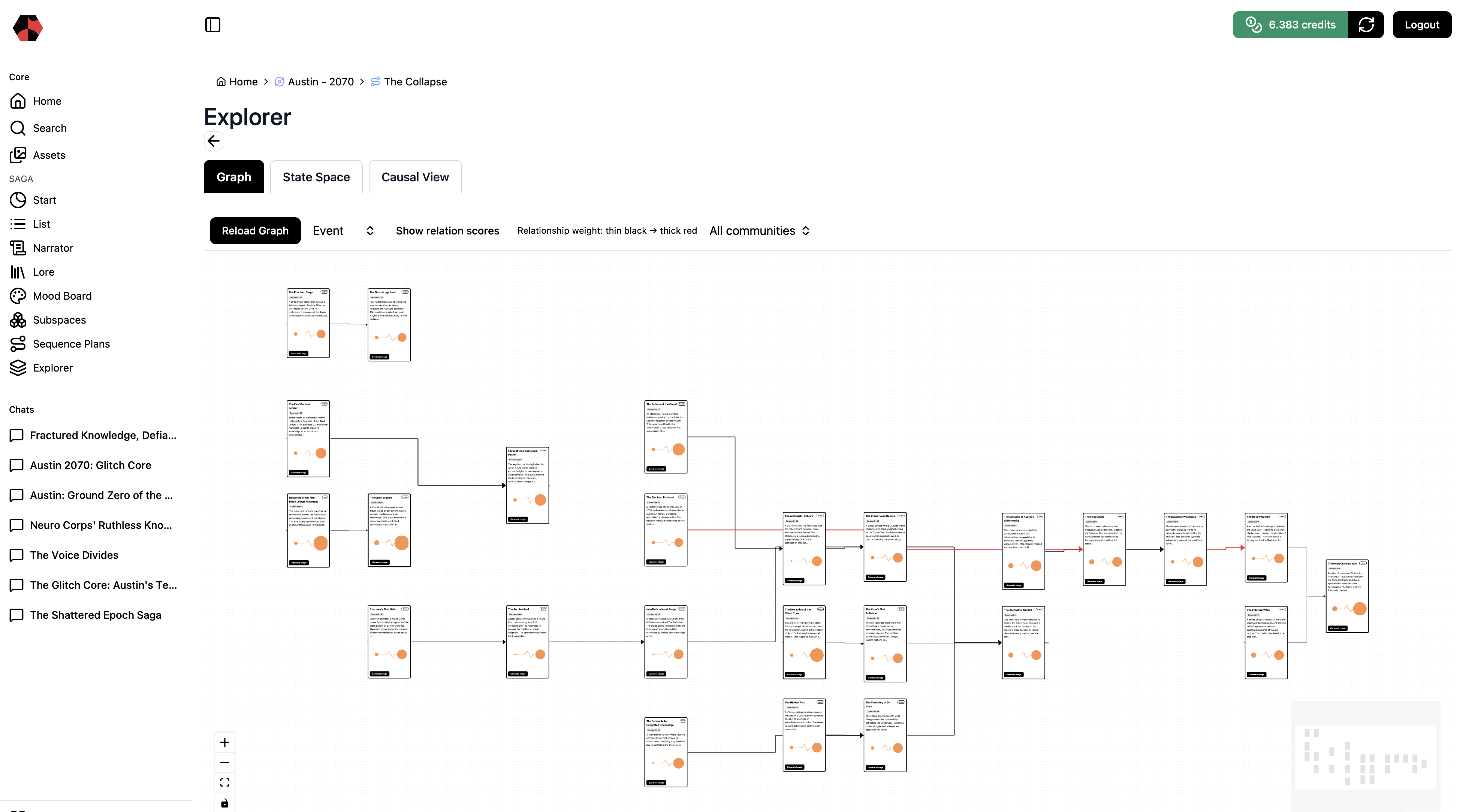
Saganode helps creators understand time through the connected events of a world. The Explorer can be controlled by element type: select Event to focus the graph on events and inspect how they lead to, influence, or depend on one another. You can then ask the Narrator about chronology, missing temporal context, or the effects of an event at a particular point in the world.
Turn chronology into usable context
- Connect historical events to the people and places they shape.
- Use the Explorer to focus on Events and investigate their relationships.
- Ask the Narrator what happened before, after, or because of an event.
- Trace a character’s knowledge, motivation, and change over time.
- Make backstory and foreshadowing easier to find and use.
- Review whether a revision changes sequence, consequence, or continuity.
This is not sequence planning. The purpose is to understand the temporal structure already present in the Universe: what happened, in which order, what changed, and which relationships give an event meaning.
Control the event view in the Explorer
Open the Explorer, stay in the Graph view, and select Event in the element-type control. The graph then concentrates on the events in the current narrative layer. Relationship lines make different strengths and directions visible, while the community control can narrow the graph further when needed.
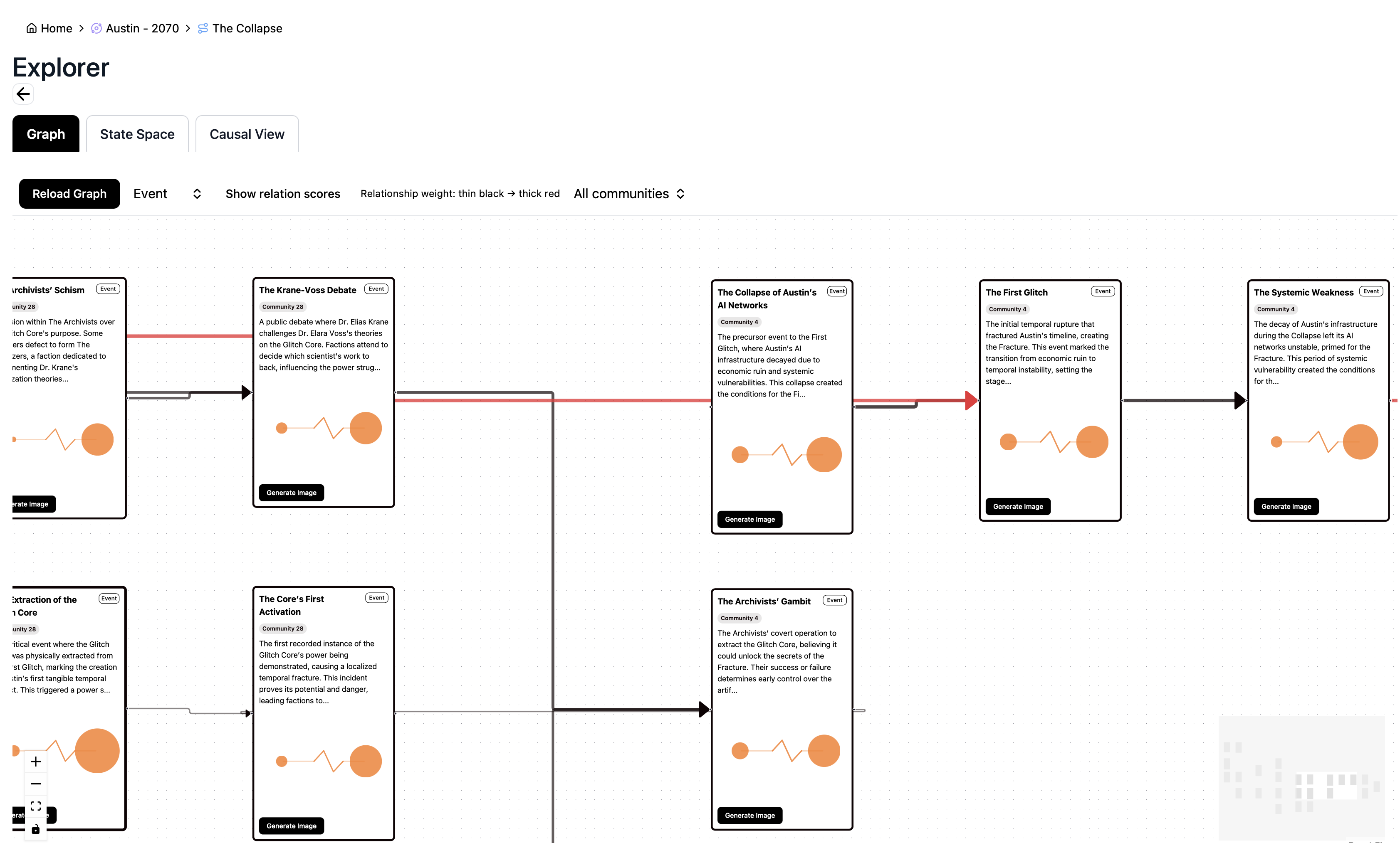
This view lets you follow the path into and out of a pivotal event without reducing the world to a simple list of dates. You can inspect which earlier events created the conditions for it and which later events inherited its consequences.
Ask the Narrator to explain the development
When the graph reveals a path that needs interpretation, ask the Narrator a focused question such as Explain the events that led to the First Glitch. The Narrator can turn the connected context into a structured explanation of eras, events, concepts, and causal relationships.
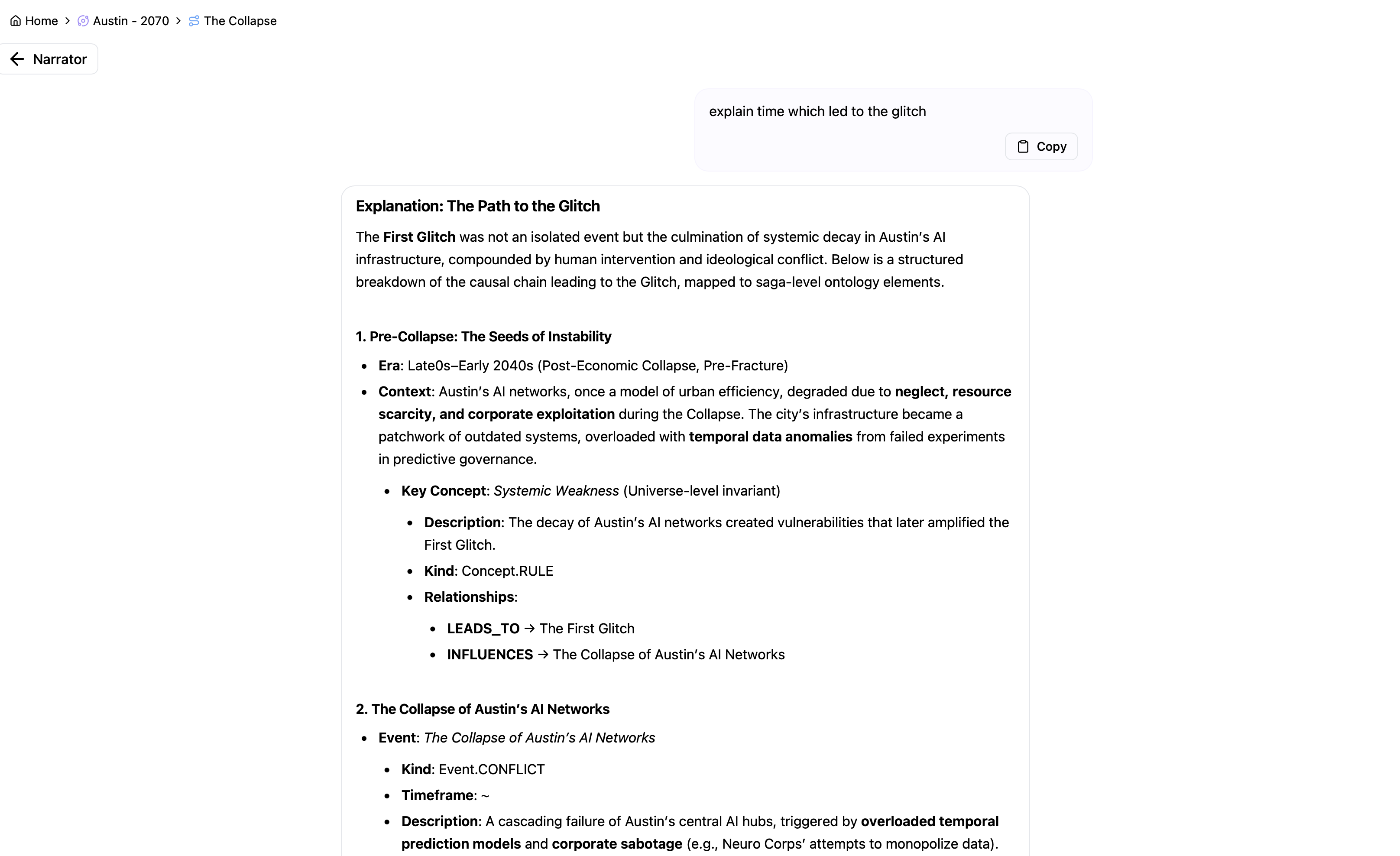
The graph provides the navigable structure; the Narrator helps explain what that structure means. The creator reviews the explanation and decides whether anything in the Universe needs to be clarified or changed.
Timelines do not lock a story into one final version. They help creators make time, change, and alternatives understandable while the world evolves.
Let the universe evolve
Growing worlds need room for revision. A new idea can reshape a character's past, split a timeline, or reveal a different future. The challenge is not avoiding change, but understanding what each change touches.
Explore alternatives in connected context, compare directions, and develop the version of the world that best serves the story while keeping its history, canon, and narrative logic available.
Build historical narratives that remember
Recurring historical formats need more than a new script prompt. Historical figures, locations, institutions, objects, and ideas return across episodes. Connect them once, then reuse the relevant context when a new story, scene, or question begins.
History is more than a sequence of dates. An event has causes, participants, consequences, and different meanings at different points in a story. Keep sources, interpretations, hypotheses, and approved editorial directions distinguishable, and carry visual conventions such as maps, portrait treatments, colour, narration tone, and recurring scene language into the next episode.
Saganode does not replace research, fact checking, or editorial judgment. It gives those decisions a connected foundation that can travel from research into visual planning.
Explore next
Give your story world a past that stays present.