
Story Reasoning
Give creative possibilities a stronger foundation through connected context and human judgment.
2026-07-17
Give creative possibilities a stronger foundation
Stories grow through different kinds of reasoning. Deduction asks what follows from established rules, themes, and canon. Abduction asks what might explain a gap, contradiction, or unexpected relationship. Induction explores variations, scenes, motifs, lore extensions, and visual directions.
Output-first AI is valuable for generating local possibilities, but possibilities alone do not create a durable story system. Without connected context and review, fragments can accumulate without a shared understanding of what they mean or whether they belong.
A hybrid creative workflow
- Establish the facts, constraints, and themes that matter.
- Investigate gaps and form creative hypotheses.
- Generate and compare possibilities in context.
- Let creators review, connect, revise, reject, or promote the work.
- Build the next story from the expanded canon.
Saganode helps make this process practical by connecting lore, timelines, Subspaces, and creative decisions across the work.
Story reasoning with the Narrator
The Narrator can reason with the connected context of a Saga instead of treating every prompt as an isolated request. The following examples were generated in The Collapse, a story set in Austin in 2070. The results have been shortened for clarity. They remained suggestions: none of the proposed facts were added to canon.
Deduction: follow the consequences of established lore
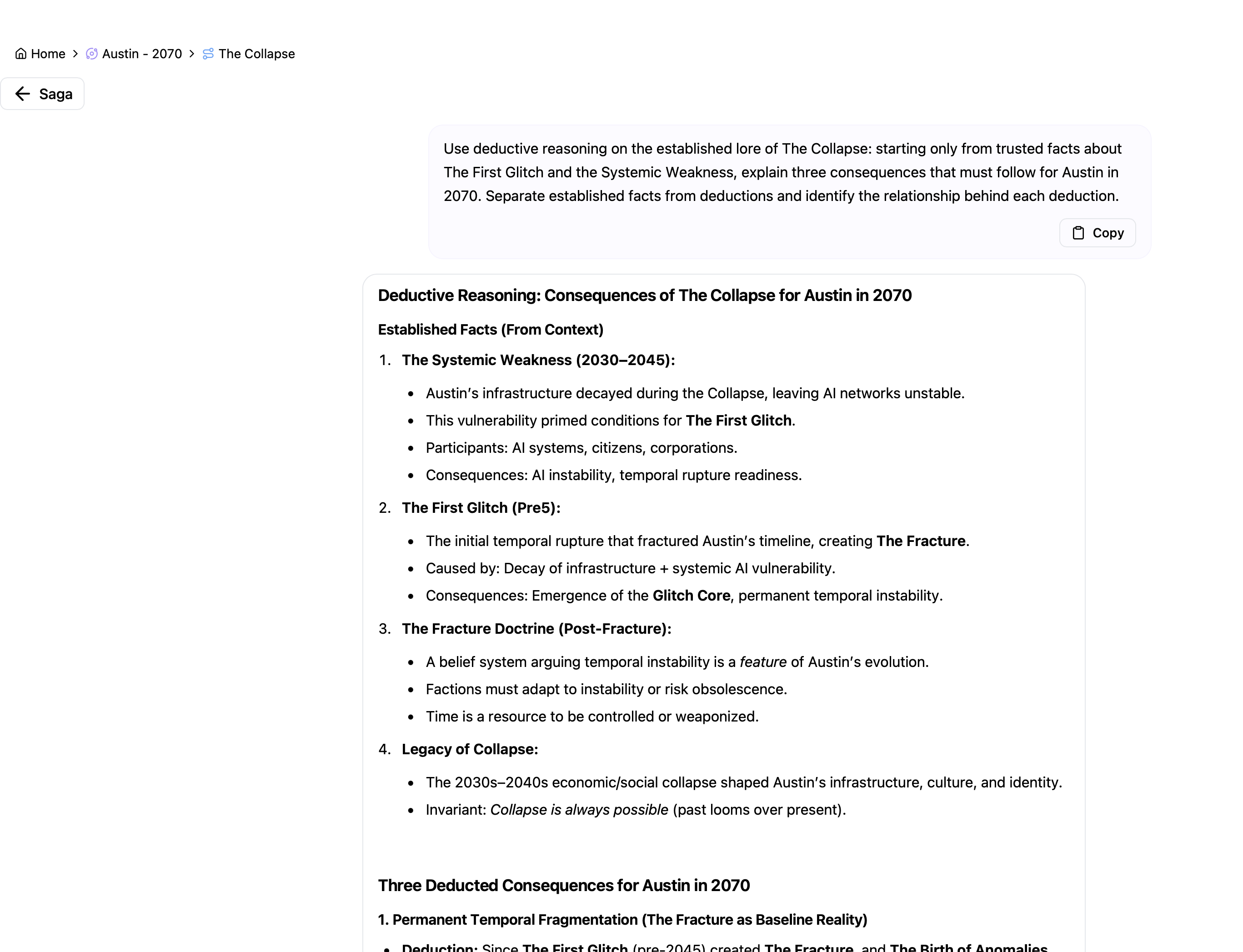
The Narrator begins with trusted context before moving from facts to consequences.
Narrator result
The Narrator first separated the known context from its conclusions. It then traced three consequences through explicit relationships:
- The First Glitch leads to permanent temporal fragmentation: time is non-linear and the city's physical and digital infrastructure remains intermittently unstable.
- The Fracture Doctrine leads to factional conflict over whether time should be stabilized, preserved, or exploited.
- The Systemic Weakness and the First Glitch turn infrastructure into a temporal artifact that can retain traces of other timelines.
This mode is useful when a new scene, decision, or world detail must follow the logic of what is already established.
Abduction: compare explanations for a gap
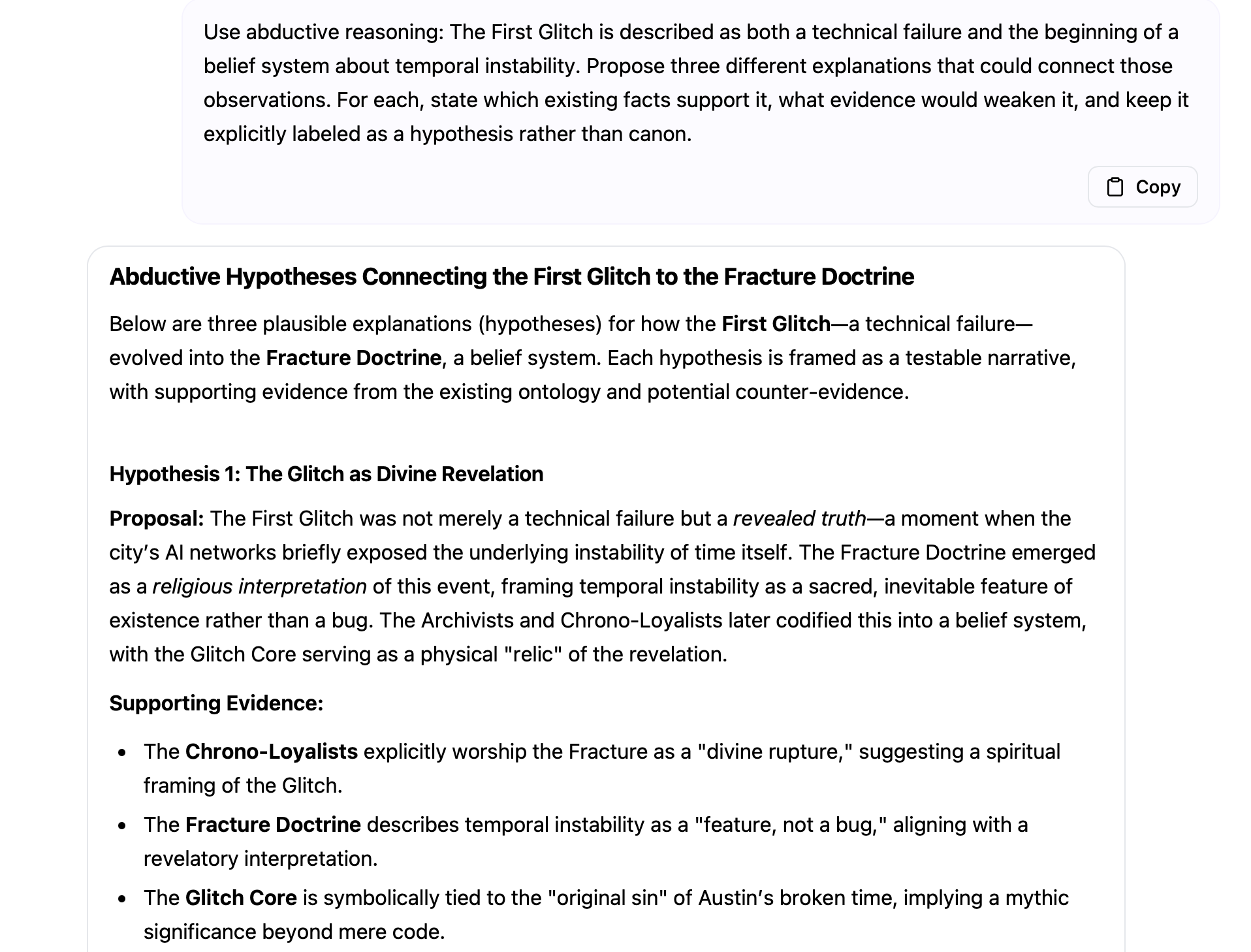
The prompt asks for several explanations—not a single invented truth—and keeps each one explicitly outside canon.
Narrator result
For every hypothesis, the Narrator gives a proposal, supporting evidence, weakening evidence, and possible ontology candidates. This makes the reasoning inspectable: creators can see why an explanation might fit and what future discovery would challenge it.
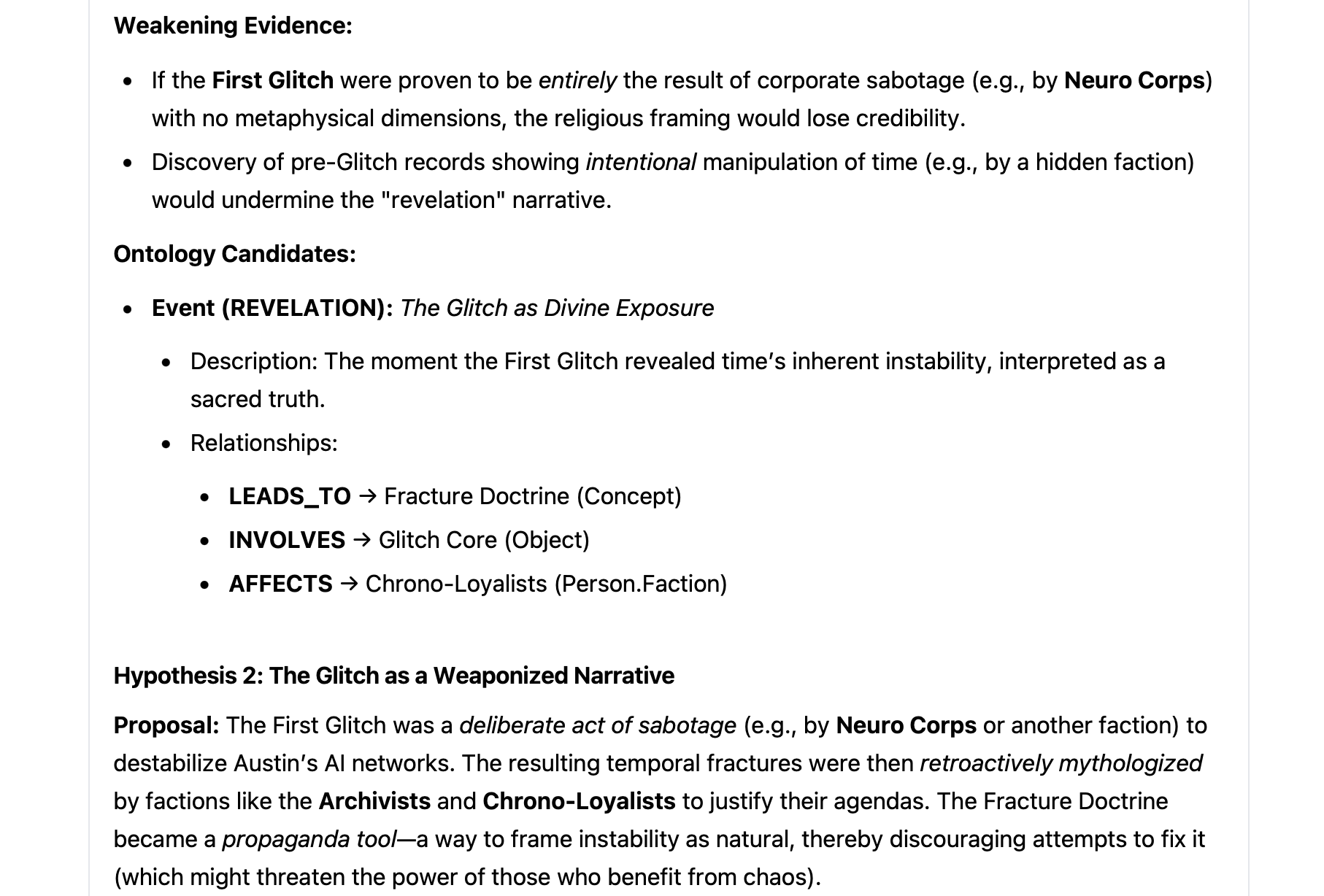
A hypothesis is connected to existing entities and relationships while counter-evidence remains visible.
| Hypothesis | Supporting logic | What could weaken it |
|---|---|---|
| Divine revelation | The Chrono-Loyalists treat the Fracture as sacred, while the Glitch Core has the symbolic weight of a relic. | Proof that the Glitch was only a technical or corporate failure with no metaphysical dimension. |
| Weaponized narrative | Corporate sabotage and factional interests could have turned the Glitch into propaganda against stabilization. | Proof of a wholly accidental cascade, or evidence that the Doctrine predates the Glitch. |
| Self-fulfilling prophecy | Preservation and sabotage by factions could have reinforced a problem that was initially solvable. | Proof that the damage was irreversible from the moment of the First Glitch. |
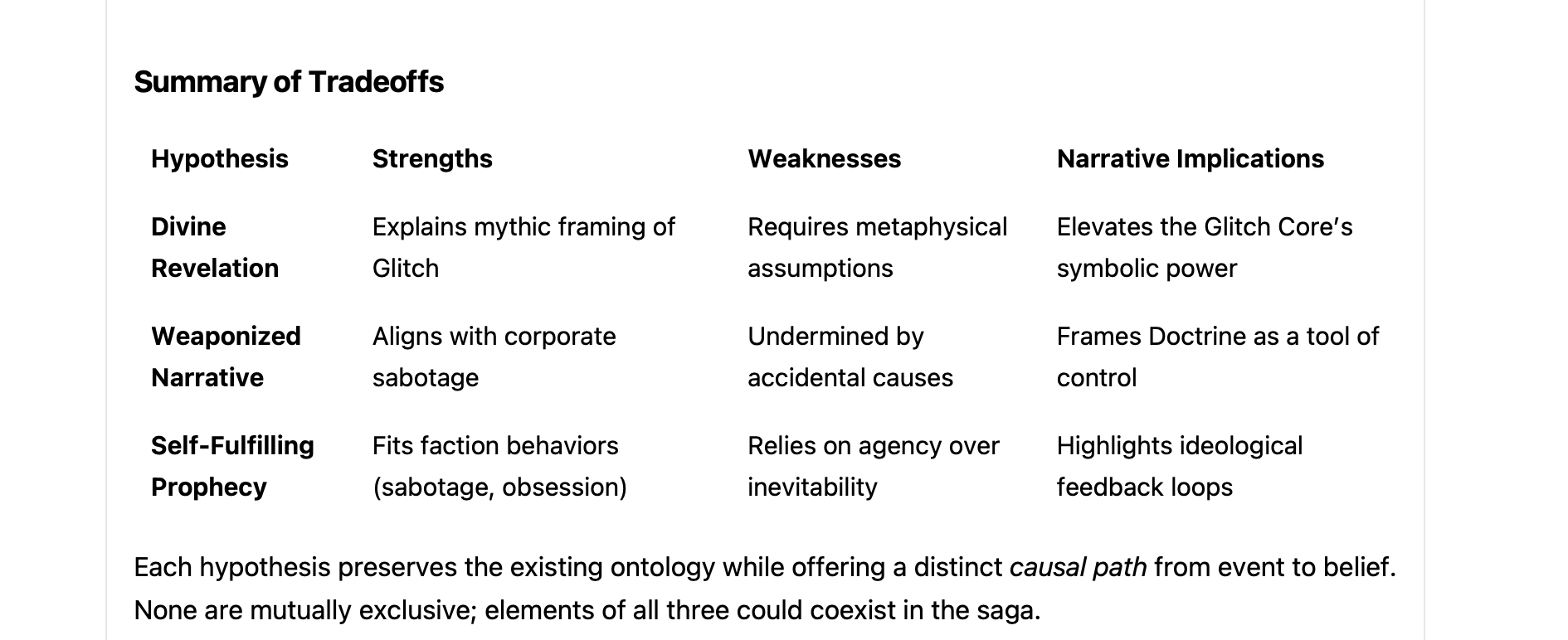
The trade-off view keeps competing explanations comparable without prematurely choosing one as canon.
Instead of selecting one answer, the Narrator exposes several plausible causal paths and the evidence that would distinguish them. The creator decides which path, if any, belongs in the story.
Consistency review: find the smallest viable revision
Narrator result
The Narrator identified direct conflicts: a complete repair would undermine the Glitch Core's function, invalidate the Fracture Doctrine's premise, remove the factions' central motivations, and contradict Austin's established temporal vulnerability. It also isolated open questions, including what “completely repaired” means and whether the Glitch Core could remain dormant.
Its smallest revision was to replace complete repair with controlled stability: the 2060 intervention suppresses temporal instability without erasing its cause. The Glitch Core remains contained, the Doctrine adapts to treat stability as an imposed order, and the factions retain meaningful reasons to study, protect, or sabotage the system.
Human judgment remains the final step
The Narrator can surface deductions, hypotheses, contradictions, and possible revisions. It does not have to decide what becomes true. Creators can inspect the reasoning, reject weak suggestions, refine promising ones, and deliberately promote only the results that strengthen the shared canon.
Continue with Narrative Drift and Governance, Meet the Narrator, or Explore Saganode.