
Narrative Drift and Governance
Let a story world evolve while keeping its context and consequences visible.
2026-07-17
Let the world evolve without losing its meaning
Drift is a natural part of creative work. A character becomes more complex, an event gains a new interpretation, a scene changes the meaning of an earlier object, or a visual direction opens a new possibility. The challenge is not to eliminate change. It is to understand it.
Saganode helps creators navigate drift by keeping context connected and consequences visible. Teams can explore a new direction, test it against the world, and decide whether it remains an experiment, becomes a branch, revises an earlier decision, or enters trusted canon.
See the shape of the world in the Explorer
The Explorer makes the current structure visible before a team changes it. Entities appear with their relationships, while communities reveal groups of strongly connected material. A community is not a verdict about what the story means. It is a structural signal: these facts, people, objects, concepts, and events currently form a closely related region of the world.
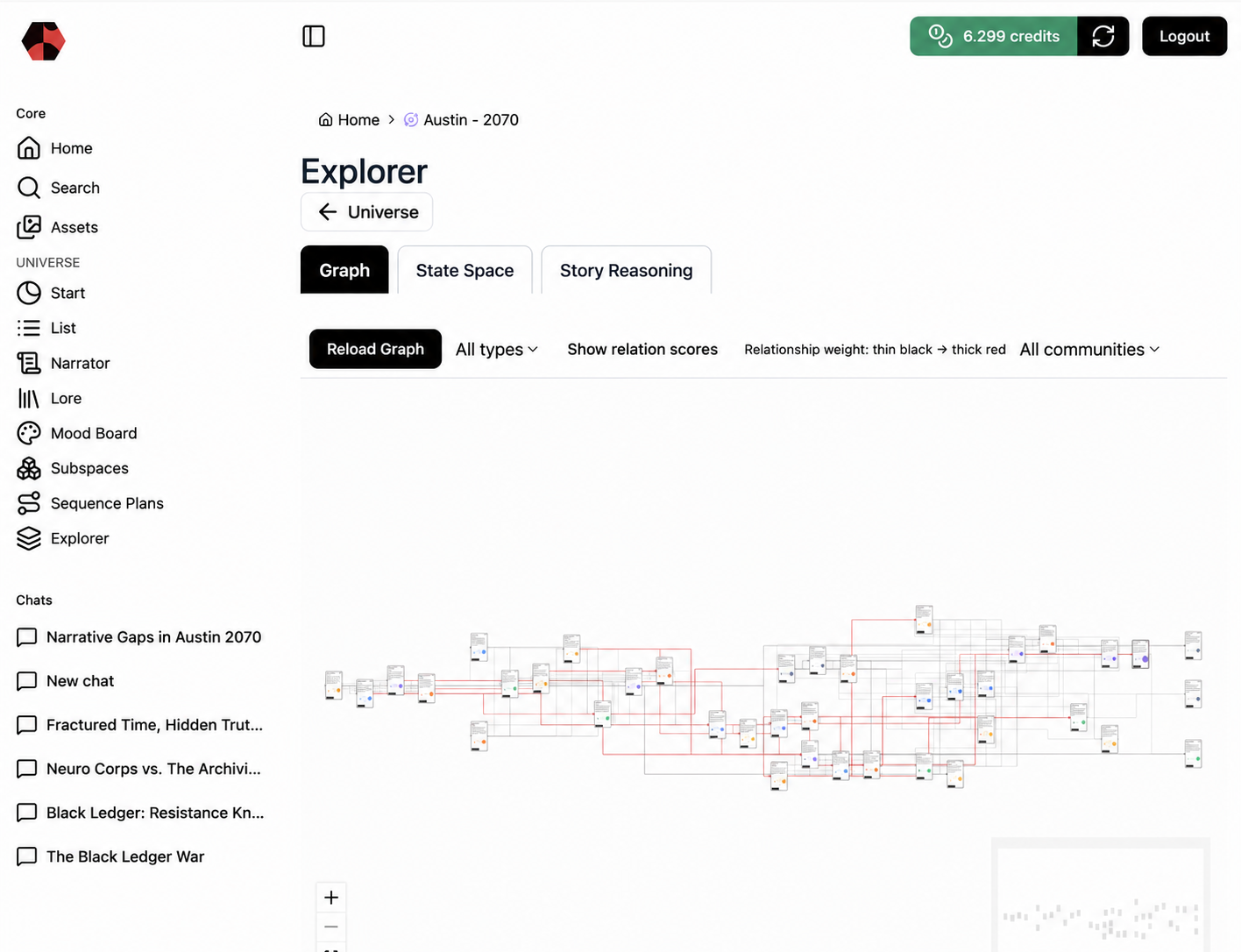
The complete graph shows how narrative regions sit inside the same universe and where relationships cross their boundaries.
This overview helps teams notice drift early. A new entity may form an isolated island, duplicate an existing idea, or connect two communities in a way that changes both. The community filter then turns a dense universe into a reviewable scope.
Review one community in context
Filtering to Community 23 isolates a connected cluster around the Black Ledger, InterPath, the Knowledge Suppression Directive, and the Great Erasure. The graph makes several governance questions visible: Is the Black Ledger an object, an ideology, or both? Does InterPath belong inside this cluster? Which event connects suppression policy to preserved knowledge?
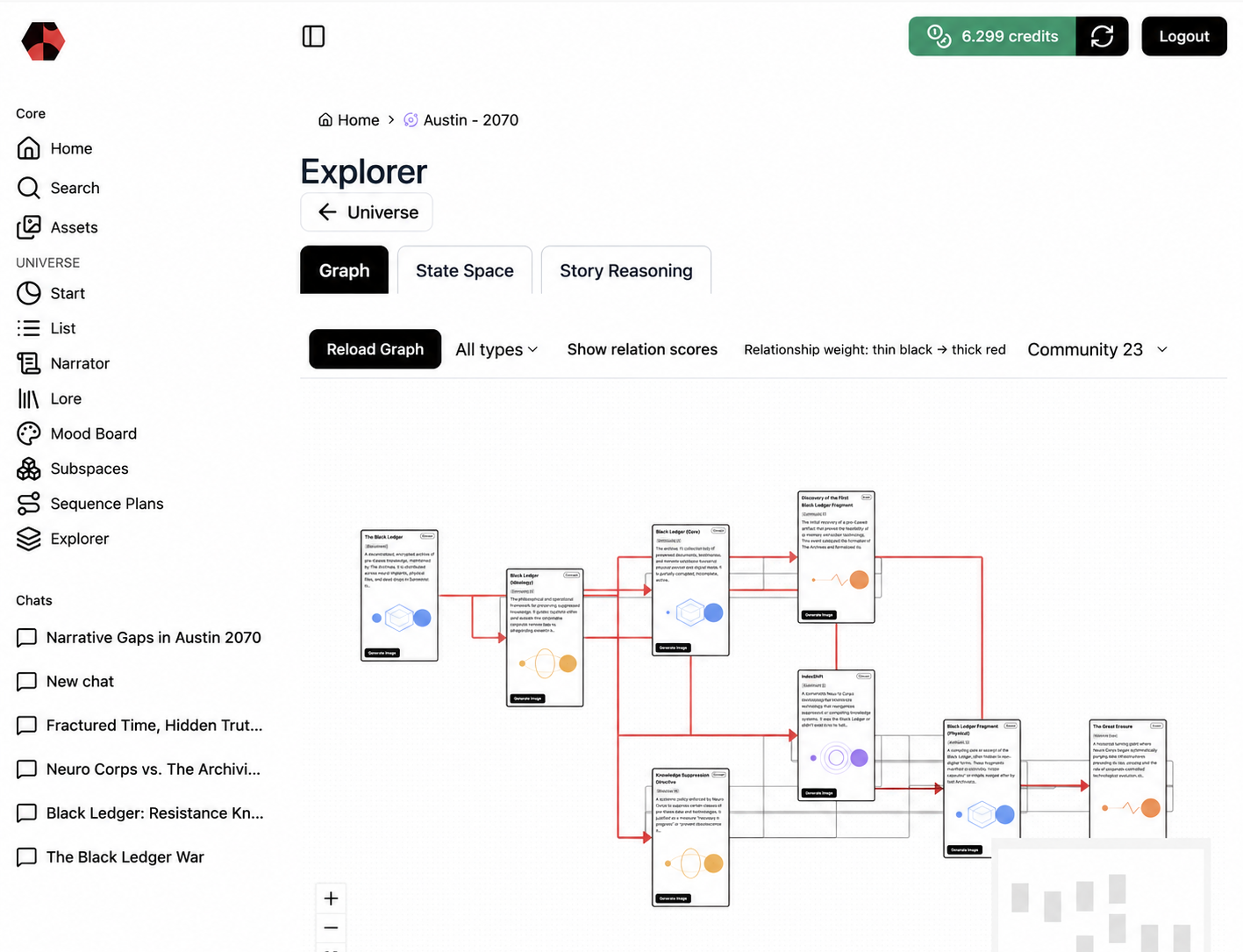
A filtered community provides a focused review surface without hiding the relationships that hold it together.
Communities are especially useful for:
- finding clusters that have developed conflicting definitions;
- identifying relationships that carry consequences into other parts of the universe;
- reviewing a coherent narrative region without treating it as an isolated document;
- deciding what the Narrator should compare against the wider canon.
Ask the Narrator to perform a governance review
Once a suspicious or fast-growing community is visible, the Narrator can compare it with the wider universe. The request should explicitly separate contradictions from open questions and keep every proposal outside trusted canon.
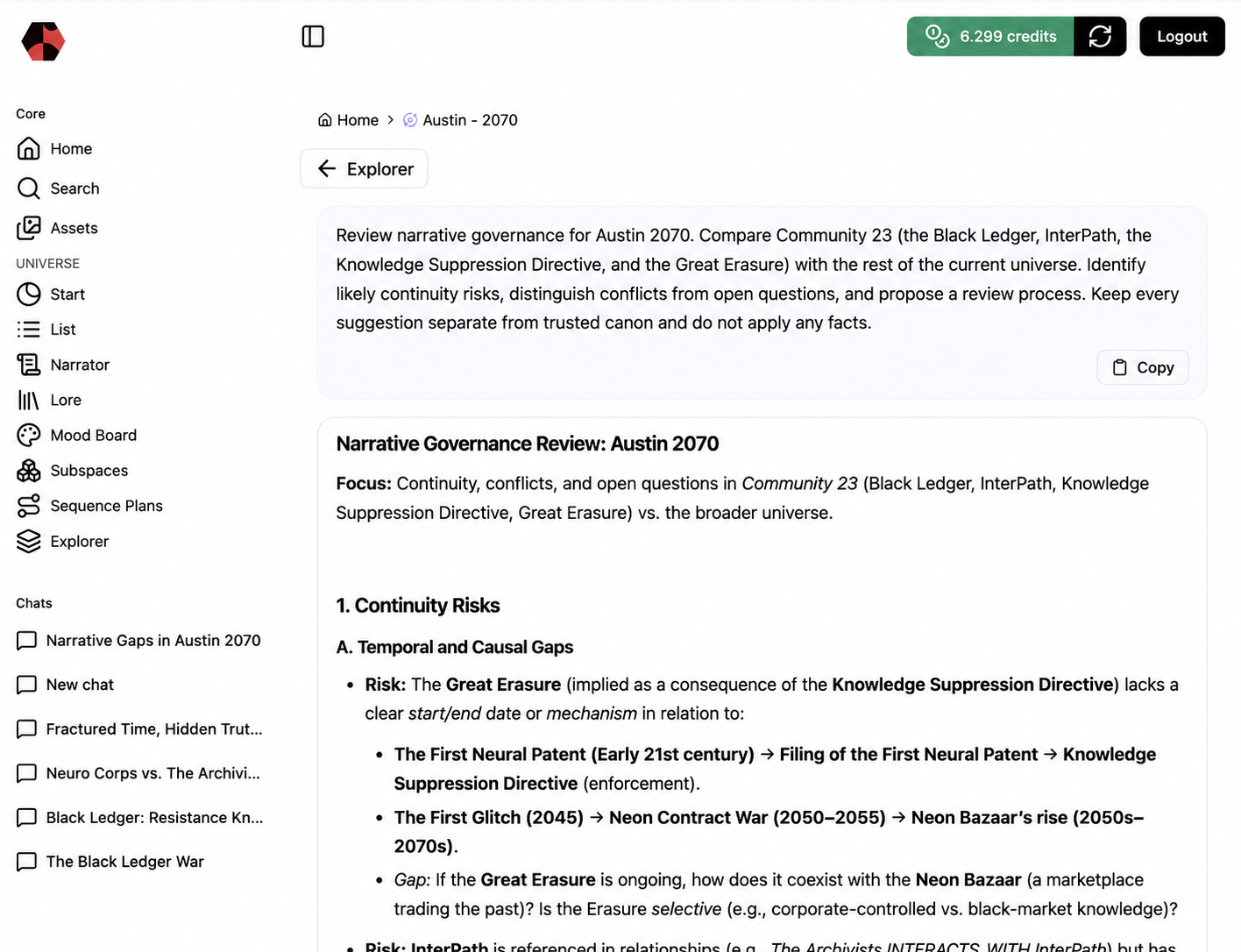
The Narrator starts with temporal and causal gaps, including the unclear duration of the Great Erasure and the undefined role of InterPath.
In this review, the Narrator surfaced three useful kinds of issue:
- Direct conflicts: the Black Ledger appears as both an ideology and an object, while the Great Erasure seems difficult to reconcile with an active market for preserved knowledge.
- Open questions: InterPath's nature and the ownership of important artifacts are unclear, but not necessarily contradictory.
- Possible resolutions: split the Black Ledger into a concept and an artifact, define selective enforcement, or clarify missing relationships and dates.
These are review materials, not automatic corrections. Recommendations can be considered individually, and proposed facts remain unselected until a creator deliberately approves them.
Govern what matters
- Separate reference material, hypotheses, recommendations, facts, and branches.
- Explore alternatives without confusing them with established context.
- Review what a change affects across relationships and timelines.
- Keep human judgment at the centre of creative decisions.
This is intentional continuity, not total control. A living canon stays useful when teams can see how it has changed and why.
A practical governance loop
- Use the full Explorer graph to see the overall structure and community boundaries.
- Filter a community that contains unclear, duplicated, or rapidly changing material.
- Ask the Narrator to compare that scope with trusted context elsewhere in the universe.
- Separate direct conflicts from productive ambiguity and unanswered questions.
- Review recommendations and proposed facts individually.
- Promote only deliberate decisions into canon, then return to the Explorer to inspect the new structure.
Continue with Story Reasoning, Lore-Building Philosophy, or Explore Saganode.