
Saganode vs. LTX Studio
Saganode grounds every sequence and shot in the connected universe behind it—preserving narrative context, continuity, and intent before production begins.
LTX Studio and Saganode meet around storyboards, but approach them from opposite directions. LTX Studio moves a production input toward generated and edited video. Saganode moves connected universe and story knowledge toward a context-rich Sequence Plan.
| Decision dimension | Saganode | LTX Studio |
|---|---|---|
| Starting point | Universe, lore, relationship, timeline, story, or event | Concept, script, image, video, or blank storyboard |
| Main outcome | Connected narrative development and Sequence Plans | Generated and edited video production |
| Consistency | Narrative entities, relationships, chronology, and intent | Reusable visual Elements across scenes |
| Storyboards | Grounded in the wider story universe | Dynamic production storyboards |
| Camera, editing, and sound | Planned for a wider production stack | Native controls, timeline, editing, and sound design |
| Model role | Model-agnostic narrative and planning layer | LTX and third-party generation models |
| Best fit | Long-running story context and upstream production planning | Fast concept-to-video execution |
Narrative Collapse: a storyboard can be consistent and still lose the story
Generative tools optimize the next output. Saganode preserves the narrative system that keeps successive outputs coherent.
LTX Studio can turn a production input into coherent-looking scenes and shots. This is inductive storytelling at production speed: each output develops from the inputs immediately available. Narrative Collapse appears when visual continuity is mistaken for narrative continuity—the character looks right, but their knowledge, motivation, relationships, or chronology no longer fit. Saganode keeps the universe model behind the production input explicit, then carries its current state into the Sequence Plan.
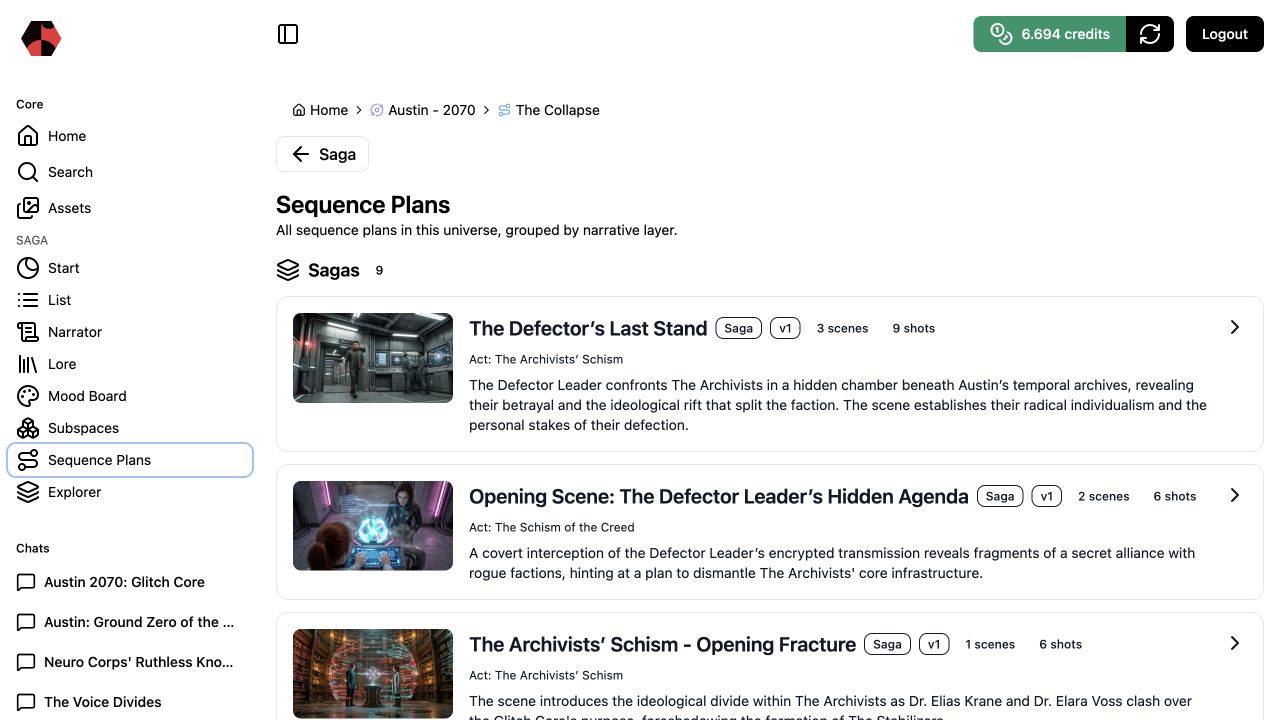
The Sequence Plan is one visible proof in a wider chain from connected lore through governed decisions to asset provenance. See all eight Narrative Collapse proofs.
LTX Studio is built for production execution
LTX Studio can start from a script, concept, image, or video and move through scenes, Dynamic Storyboards, shots, camera direction, keyframes, sound, and timeline editing. Its Elements system helps maintain visual characters, objects, and locations across scenes.
Those are meaningful production strengths. Saganode does not replace LTX Studio's generation models, Timeline Editor, sound tools, camera controls, or rendering workflow.
Saganode begins before the production input
The earlier question is whether the concept or scene is the right development for the story universe. Saganode connects the sequence to characters, relationships, events, lore, chronology, and the meaning of what changes.
Visual consistency answers whether a character looks the same. Narrative continuity also asks what the character knows, what they want, which relationships constrain them, and why this particular shot belongs in the sequence.
Explore narrative coherence and continuity
Sequence Plans preserve the reason behind the shot
A Saganode Sequence Plan connects narrative function to scenes, shots, dialogue, camera choices, visual references, and related production assets. It provides a structured handoff: the production tool receives not just a prompt, but direction grounded in the story.
LTX Studio can then be the execution environment where that direction becomes storyboard frames, controlled shots, sound, edits, and finished video.
See the story-to-storyboard workflow
Can Saganode and LTX Studio work together?
Yes in a complementary workflow. Use Saganode to develop and govern the narrative foundation, then carry selected sequence and shot direction into LTX Studio for generation and assembly. The exact handoff depends on current export, API, and project capabilities.
Frequently asked questions
Is Saganode an LTX Studio alternative?
They overlap in visual planning, but are not direct substitutes across the full workflow. Saganode centers narrative development and upstream intent; LTX Studio centers production, generation, editing, and delivery.
Which tool is better for storyboards?
LTX Studio specializes in moving a storyboard into generated shots and an editing timeline. Saganode's strength is keeping that storyboard connected to the wider universe, timeline, and story logic.
Does Saganode generate finished AI video?
Saganode organizes narrative context, Sequence Plans, storyboards, and production assets. Dedicated generation and finishing remain part of the wider toolchain.
Explore next
Primary sources
- LTX Studio product overview
- LTX Studio platform, API, and self-hosting guide
- Saganode Sequence Plans tutorial
- Saganode production asset workflow
Product information reviewed September 4, 2026. Models, features, and commercial terms may change.